

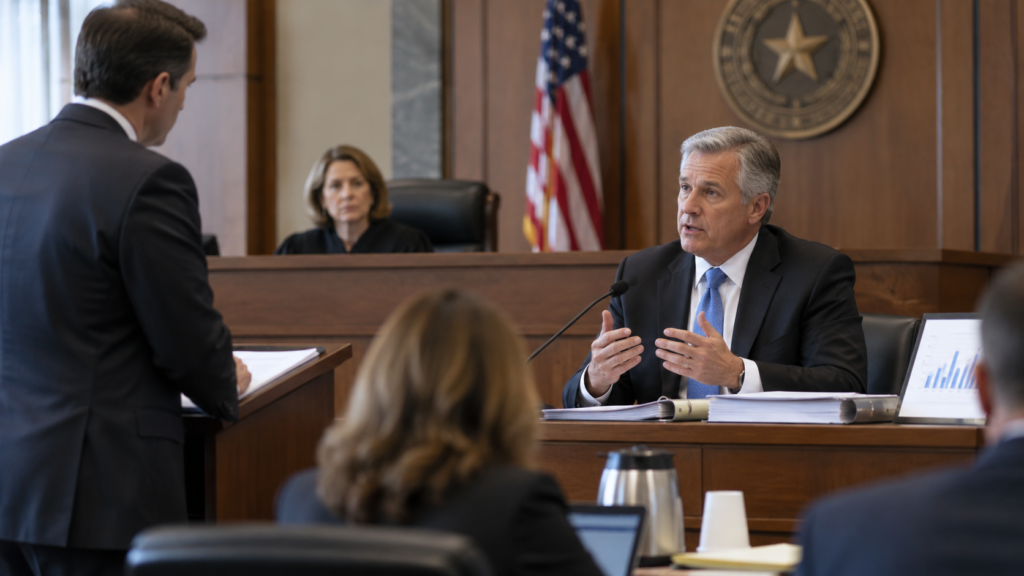
When a business dispute escalates to litigation or bankruptcy reaches federal court, the quality and credibility of the expert witness can shape the outcome. In financial disputes involving solvency, damages, fraudulent transfers, or business valuation, expert analysis and testimony may carry the case. Yet attorneys and business owners can underestimate the preparation, credentials, and courtroom experience required to withstand rigorous cross-examination.
For Texas businesses navigating bankruptcy court, commercial litigation, or shareholder disputes, understanding what to expect from a financial expert witness, and how to select the right one, is essential.
The Role of a Financial Expert Witness in Litigation and Bankruptcy
A financial expert witness serves a different function than a fact witness or consulting advisor. The expert applies specialized knowledge, professional methodology, and disciplined analysis to complex financial questions, then communicates findings clearly to a judge, jury, or mediator.
In bankruptcy and commercial litigation, the expert’s work may include reports, financial models, and schedules that reconstruct financial positions, quantify damages, or assess solvency at a critical point in time. The expert must defend assumptions, data sources, and conclusions under cross-examination.
The most effective financial experts are not merely academics. They are practitioners who have managed real-world financial decisions and navigated the situations they are asked to evaluate. This operational credibility allows them to speak from experience, not just theory.
Common Disputes That Require Expert Financial Testimony
Financial expert testimony arises across bankruptcy and commercial disputes.
Solvency and Insolvency Analysis. In fraudulent transfer, preference, and fiduciary duty cases, whether a business was solvent on a specific date may be central. The expert applies accepted tests, balance sheet insolvency, cash flow insolvency, and adequate capital, using defensible methodology and contemporaneous data.
Damages Quantification. For lost profits, breach of contract, or business interruption claims, the expert must isolate causation, project reasonable outcomes, and apply appropriate discount rates. Speculative or results-driven methodologies invite challenge.
Business Valuation Disputes. In shareholder disputes, divorce proceedings involving business interests, tax matters, and Section 363 sales, experts may apply income, market, and asset-based valuation approaches and reconcile them with the entity’s circumstances.
Asset Tracing and Commingling. In matters involving misappropriation, fraudulent transfers, or Ponzi-style schemes, experts may trace funds through complex accounts to determine whether assets were commingled or diverted.
Preference and Avoidance Actions. Bankruptcy experts may analyze ordinary-course payments, debtor insolvency at the time of transfer, or whether transfers constituted fraudulent conveyances under applicable law such as the Texas Uniform Fraudulent Transfer Act (TUFTA).
Qualifications That Matter in a Financial Expert Witness
Not every financial professional is qualified to serve as an expert witness. Several factors matter.
Professional Credentials. Credentials such as CPA, CFF, CIRA, and CDBV demonstrate specialized knowledge in forensic accounting, restructuring, and valuation.
Courtroom Experience. Cross-examination is a skill-tested environment. Experienced experts know how to maintain composure, answer precisely, and avoid damaging concessions. A history of qualifications in federal, state, and bankruptcy courts also provides confidence that testimony can withstand Daubert and evidentiary challenges.
Operational Background. Experts who have served as CFOs, controllers, or chief restructuring officers bring practical understanding to their opinions. Experience managing liquidity crises, public companies, or restructurings can make testimony more grounded and difficult to dismiss.
Independence and Objectivity. Courts scrutinize whether an expert is neutral or acting as an advocate. Experience as a court-appointed trustee, receiver, or fiduciary can demonstrate objectivity and service to multiple stakeholders.
What Separates a Credible Expert from a Vulnerable One
Credibility under cross-examination often comes down to methodology and discipline.
Transparent Methodology. Credible experts document data sources, assumptions, adjustments, and alternatives. They can explain why a methodology was selected and do not cherry-pick information to support a client’s position.
Consistency Across Engagements. Applying fundamentally different approaches depending on which side retained the expert creates impeachment risk. Consistency, while adapting analysis to the facts, demonstrates professional integrity.
Composure Under Pressure. Cross-examination is designed to challenge and corner. Experienced experts remain measured and precise without becoming defensive or argumentative.
Clarity of Communication. Strong analysis has limited value if the fact-finder cannot understand it. Effective experts translate complex financial concepts into accessible language without oversimplifying them.
Selecting the Right Expert Witness for Your Case
Selection should be deliberate. First, determine whether the expert’s experience matches the case. A general forensic accountant may lack the restructuring, valuation, or insolvency experience necessary for a specific dispute.
Second, review the expert’s testimony record: prior qualifications, courts, exclusions, and disqualifications. A strong record provides assurance that credentials and methodology can withstand scrutiny.
Third, determine who will actually perform the work. In some firms, junior staff conduct much of the analysis while the named expert is briefed later. An expert who personally leads the engagement and understands every material detail is more defensible under cross-examination.
Finally, evaluate collaboration with counsel. Strong experts understand litigation strategy, anticipate challenges, avoid overreaching, and identify financial strengths and weaknesses early.
Frequently Asked Questions
What types of cases require a financial expert witness?
Financial experts are commonly used in bankruptcy, commercial litigation, shareholder disputes, fraudulent transfer and preference actions, damages claims, valuation disputes, divorce matters involving businesses, and fiduciary duty litigation.
How is an expert witness different from a financial consultant or advisor?
An advisor helps clients make business decisions. An expert witness provides independent analysis to a court or tribunal and must defend it under cross-examination. The expert’s duty is to provide truthful, supported opinions rather than advocate for an outcome.
What credentials should I look for in a financial expert witness?
Relevant credentials include CPA, CFF, CIRA, CDBV, and CTP. Courtroom experience, operational background, and a history of objective analysis are equally important.
Can an expert witness be challenged or excluded?
Yes. Under Daubert and the Federal Rules of Evidence, an expert’s qualifications, methodology, or relevance may be challenged. Unreliable or improperly applied methodology can result in exclusion.
How early in a case should an expert witness be engaged?
As early as practical. Early involvement can help identify relevant documents, shape deposition questions, and develop preliminary analyses that inform strategy. Late engagement can limit the time available for thorough, defensible work.
Conclusion
In financial disputes, the expert witness can be the linchpin of the case. Whether the issue is solvency, damages, or business valuation, the expert’s credibility, qualifications, methodology, and courtroom experience can shape the outcome. For Texas attorneys and business owners, selecting the right expert is a consequential litigation decision.
John Tittle, Jr. brings over 100 expert witness appearances in federal and state courts since 1983, with credentials including CPA/CFF/CGMA, CTP, CIRA, and CDBV. A former Deloitte Partner and public company CFO with experience as a court-appointed trustee and receiver, he combines operational credibility, forensic expertise, and courtroom-tested composure through a principal-led model in which he personally leads every matter.
Schedule a confidential consultation with John Tittle, Jr. at tittlefinancial.com or call (214) 341-6043.
Retaining a Financial Expert Witness?
See our Financial Expert Witness for Attorneys page for credentials, retention process, and case types.